
- EMOM - Kid's Virtual Mother


Birds

Bird Sanctuaries
July 30, 2019
Insects
July 30, 2019
Written by: Devrat Agrawal
- Birds are warm-blooded, egg-laying animals that have vertebrae, or a backbone. They are different from mammals because they lay hard-shelled eggs and have feathers.
- Birds are the only animals that have feathers, and not all birds fly.
- According to the website “Where in City,” there are about 10,000 living species, or different kinds, of birds.
Some Examples are:
| Birds | Basic Information |
|---|---|
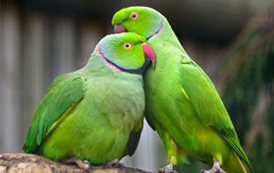 Parrots Parrots |
1. Parrots, birds of the roughly 393 species. 2. They are found in most tropical and subtropical regions. 3. Characteristic features of parrots include a strong, curved bill, an upright stance, strong legs, and clawed zygodactyl feet. 4. Many parrots are vividly colored, and some are multi-colored. |
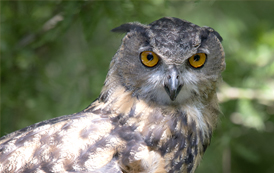 Owls Owls |
1. They include about 200 species. 2. They have upright stance, a large, broad head, binocular vision, binaural hearing, sharp talons, and feathers adapted for silent flight. 3. Owls are known for their disproportionally large eyes in comparison to their skulls. 4. Most owls are nocturnal, actively hunting their prey in darkness. |
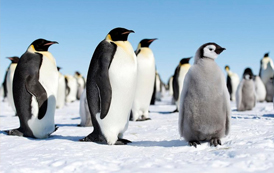 Penguin Penguin |
1. Penguins are a group of aquatic flightless birds. 2. Highly adapted for life in the water their wings have evolved into flippers. 3. The largest living species is the emperor penguin on average, adults are about 1.1 m tall and weigh 35 kg. The smallest penguin species is the little blue penguin also known as the fairy penguin, which stands around 40 cm tall and weighs 1 kg. |
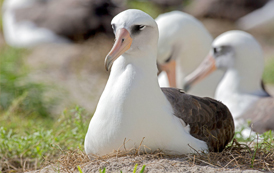 Albatross Albatross |
1. These are large seabirds. 2. Albatrosses are among the largest of flying birds. 3. Of the 22 species of albatrosses recognized by the IUCN, all are listed as at some level of concern; three species are critically endangered, five species are endangered, seven species are near threatened, and seven species are vulnerable. |
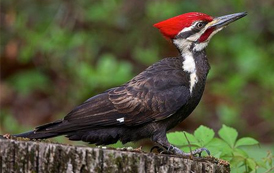 Woodpecker Woodpecker |
1. Members of this family are found worldwide, except for Australia, New Guinea, New Zealand, Madagascar, and the extreme polar regions. 2. They mostly nest and roost in holes that they excavate in tree trunks, and their abandoned holes are of importance to other cavity-nesting birds. 3. Woodpeckers are part of the family Picidae.The family Picidae includes about 240 species. |
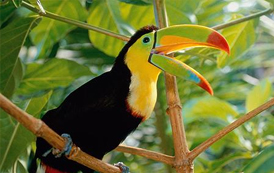 Toucan Toucan |
1. They are brightly marked and have large, often-colorful bills. 2. There are over forty different species. 3. Toucans are arboreal and typically lay 2–21 white eggs in their nests. 4. They make their nests in tree hollows and holes excavated by other animals such as woodpeckers—the toucan bill has very limited use as an excavation tool. |
Some facts:
- Parrots, along with ravens, crows, jays, and magpies, are among the most intelligent birds, and the ability of some species to imitate human voices enhances their popularity as pets.
- Kiwis are endangered, flightless birds that live in New Zealand. They lay the largest eggs relative to their body size of any bird in the world.
- Hummingbirds can fly backwards.
- The Bee Hummingbird is the smallest living bird in the world, with a length of just 5 cm (2 in).
- The Ostrich is the largest bird in the world. It also lays the largest eggs and has the fastest maximum running speed (97 kph).

EMOM
test
Related posts



